Streamline Your Practice with a Psychiatry H&P Clinical Template
In the fast-paced world of mental healthcare, clarity and consistency are not just conveniences—they are necessities. For psychiatrists, residents, and mental health professionals, the initial evaluation sets the tone for treatment, legal documentation, and patient care. A well-structured Psychiatry H&P Clinical Template is more than a form; it is the foundational framework for every patient interaction, ensuring no critical detail is overlooked while saving valuable clinical time.
The Anatomy of an Effective Psychiatric Evaluation
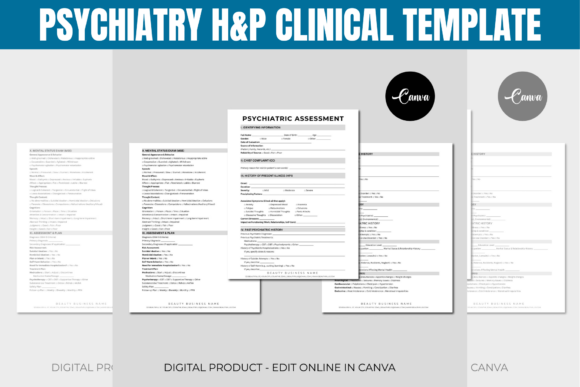
Think of this template as the architectural blueprint for a patient's mental health story. It provides a logical, sequential flow that mirrors the natural progression of a psychiatric interview. The Initial Psychiatric Evaluation Note section is designed to capture the patient's Chief Complaint & History of Present Illness in their own words, followed by a structured exploration of Past Psychiatric & Medical History. This systematic approach ensures you build a complete picture, covering Substance Use, Social, and Family History without redundancy.
The template's strength lies in its comprehensive yet flexible design. It includes dedicated spaces for the Mental Status Examination (MSE), a critical snapshot of the patient's current psychological state. Furthermore, it outlines DSM-5 Criteria and a Risk Assessment, guiding the clinician through the diagnostic and safety considerations that are paramount in a first evaluation. The final sections for a Treatment Plan & Follow-Up Notes create a seamless transition from assessment to action, establishing clear next steps for both provider and patient.
Practical Applications for Diverse Professionals
While designed for clinical settings, the utility of a professional Psychiatry H&P Clinical Template extends across various roles. For medical students and psychiatry residents, it is an invaluable educational tool, teaching the discipline of thorough documentation and the hierarchy of clinical information. It acts as a training wheel that develops into a professional habit, ensuring that from day one, their notes are organized, defensible, and clinically useful.
For practicing clinicians and clinic administrators, standardization is key. Using a consistent template for medical students and staff streamlines the intake process, reduces variability in documentation, and enhances communication across the care team. When notes follow a predictable structure, reviewing a patient's history for a consultation, insurance review, or handoff becomes significantly more efficient. The clean, professional layout is also designed to integrate smoothly with Electronic Health Records (EHR) or to be printed for physical charts, offering flexibility for any practice environment.
Customization: Making the Template Your Own
A rigid template can stifle clinical nuance, which is why this resource is built for adaptability. Fully editable in platforms like Canva, it allows you to customize fields, adjust headings, and incorporate your clinic's branding. You can modify the level of detail in the Family History section to suit a child psychiatry practice versus an adult one, or expand the Social History area for forensic evaluations. This level of customization ensures the template serves your specific assessment style and patient population, rather than forcing you into a one-size-fits-all mold.
The included Professional Invoice & Receipt Templates are a practical bonus, acknowledging that clinical care exists within a business framework. Having a cohesive set of documents—from clinical notes to billing—reinforces a practice's professionalism and attention to detail, which patients and insurers alike appreciate.
Choosing and Implementing Your Documentation Framework
Selecting the right documentation template is a strategic decision. Evaluate its structure against your workflow: Does the Mental Status Examination section prompt you for all necessary domains? Is the Risk Assessment thorough enough for your setting? Consider the readability of the layout itself; clear headings, adequate white space, and logical grouping reduce cognitive load during a busy clinic day.
Test the template with a few real or simulated cases before full implementation. Does it capture the complexity of a patient with multiple comorbidities? Can you easily locate the Treatment Plan for a quick review? Think of it as a font pairing exercise in design—the right combination of structure and flexibility creates harmony and function. Just as a serif font can convey tradition and reliability in a law firm's branding, a well-organized clinical template conveys thoroughness and competence in a healthcare setting.
Ultimately, this Psychiatry H&P Clinical Template is a foundational design asset for your practice's brand identity—the brand of meticulous, patient-centered care. It transforms the administrative task of documentation into a streamlined, reliable process, freeing up more of your time and mental energy for what matters most: the patient in front of you.